
How to Reduce Human Error in Pharmaceutical Operations
Why retraining alone rarely works, and the practical controls that reduce human error in pharmaceutical manufacturing, packaging and documentation.
 Pharmaceutical Guideline8 min read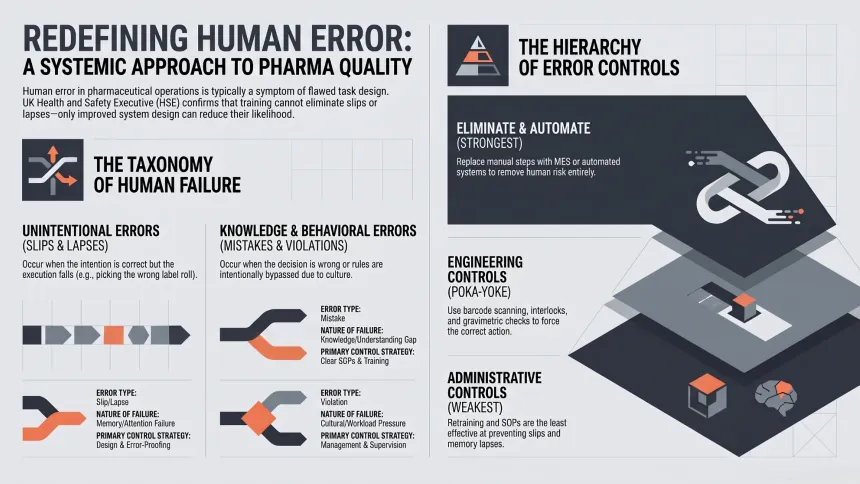
Human error in pharmaceutical operations is rarely a problem of careless people. It is usually a problem of tasks, procedures and workplaces that make the wrong action easy. The most effective way to reduce it is to design errors out, with barcode checks, clearer batch records and fewer interruptions, and to use training for the errors that training can actually fix.
Key points
- Human error has four types: slips, lapses, mistakes and violations. Each needs a different control.
- Retraining does not prevent slips and lapses; better design does.
- A risk assessment finds error-prone steps before they cause deviations.
- “Human error” is not a root cause. Investigate why the error was likely.
- Measure success with right-first-time and repeat-deviation trends, not training records.
What counts as human error in pharmaceutical operations?
Human error in pharmaceutical operations encompasses any action that deviates from standard procedures or expected outcomes, categorised primarily into slips, lapses, mistakes, and violations. Understanding these categories is the first step to applying the right preventive measure.
The UK Health and Safety Executive (HSE) classifies human failures into these four distinct types. A slip occurs when someone does something, but not what they meant to do. A lapse is a failure of memory. A mistake happens when someone does the wrong thing believing it to be right. A violation is an intentional deviation from the rules.
| Type | What happens | Pharmaceutical example | Best control |
|---|---|---|---|
| Slip | Right intention, wrong action | Picking the adjacent label roll at changeover | Barcode verification, physical segregation |
| Lapse | A step is forgotten | Missing an in-process check or signature in the batch record | Checklists, mandatory fields, system prompts |
| Mistake | Wrong decision or understanding | Wrong potency-adjusted quantity calculation | Training on clear procedures, calculation templates |
| Violation | Deliberate shortcut, usually well-meant | Skipping line clearance under time pressure | Realistic workload, supervision, reporting culture |
Treating every error as a “mistake” leads to the common trap of relying solely on retraining. To solve the problem, you must correctly identify which of these four failures actually occurred.
Why does retraining rarely fix human error?
Retraining rarely fixes human error because many deviations in manufacturing and packaging are slips and lapses, which the HSE confirms cannot be eliminated by training; rather, improved design can reduce their likelihood. Training only addresses gaps in knowledge, skill, or understanding.
According to HSE’s HSG48 (Reducing error and influencing behaviour), highly trained operators still experience memory lapses or physical slips, especially when fatigued, distracted, or performing highly repetitive tasks. If an operator accidentally picks up a 250mg carton instead of a 500mg carton because they look identical and are stored next to each other, reading the SOP again will not prevent it from happening next week.
Mistakes, on the other hand, do require training with well-written procedures, as the operator misunderstood the requirement. Violations require management intervention regarding workplace culture, supervision, and workload. By matching the intervention to the error type, quality units can stop wasting time on ineffective retraining and start engineering out the risk.
Where do human errors happen most?
Human errors happen most frequently during transitions, calculations, and highly repetitive tasks where attention naturally wanders. Across oral solid and sterile manufacturing floors, the highest-risk zones commonly include label changeovers, weighing and dispensing, line clearances, batch record entries, and aseptic interventions.
Label changeovers are particularly prone to slips. A common deviation involves an operator loading the correct label roll, but splicing it with a leftover tail of the previous batch’s label roll because the physical clearance of the splicing station is inadequate. Both labels look identical at a glance.
Weighing and dispensing see frequent mistakes regarding potency-adjusted calculations or tare weights. Line clearance failures are classic lapses; operators look at a machine so often they develop “inattentional blindness,” failing to see a stray tablet resting right on the conveyor guide rail.
Batch record documentation suffers heavily from lapses—missing signatures or timestamps—especially when a single page requires twenty different manual entries. Finally, for sterile sites compliant with EU GMP Annex 1, aseptic interventions require complex ergonomic movements. When operators feel rushed, well-intentioned violations occur, such as reaching over open product to clear a jam faster, compromising unidirectional airflow.
How do you find error-prone steps before they cause a deviation?
You find error-prone steps by conducting a proactive risk assessment of critical manufacturing and packaging steps, involving the operators who actually do the work. The goal is to identify points in the process where human failure is both highly likely and highly consequential.
The best approach is to walk the floor during live operations. Look for workarounds, confusing batch record pages, or crowded staging areas. However, ICH Q9(R1) (Quality Risk Management) warns about subjectivity in risk assessments. It states that subjectivity can impact hazard identification and risk estimation. To counter this, rely on historical deviation data, near-miss logs, and direct operator feedback rather than just QA assumptions.
Use tools like Failure Mode and Effects Analysis (FMEA) to evaluate the complexity of tasks, the clarity of instructions, and the environment (lighting, noise, distractions). Once critical steps are mapped, you can systematically apply controls to mitigate them. For more on applying risk principles accurately, see our guide on Quality Risk Management.
Which controls reduce human error?
Controls that reduce human error follow a strict hierarchy: physical elimination and error-proofing are the strongest, while administrative controls like SOP simplification, verification, and training are the weakest but most common. Implementing a mix of these controls is the most robust strategy.
Eliminate and Automate: The ultimate control is removing the human element from a critical step. If calculation mistakes plague the dispensary, implement an automated Manufacturing Execution System (MES) that pulls tare weights directly from the scale balance.
Error-Proofing (Poka-Yoke): Where automation isn’t possible, force the correct action. In packaging operations, the most effective control for label slips is barcode scanning. If the line scanner reads a 250mg barcode on a 500mg run, the machine interlock immediately stops the line. Similarly, gravimetric checks—where a carton is rejected if its weight indicates a missing leaflet—physically prevent lapses from reaching the patient.
Simplify Procedures: SOPs and batch records are often written for auditors, not operators. Simplify SOPs to feature one clear action per step and integrate visual aids. A photo showing the exact location of a machine sensor is vastly superior to a dense paragraph of text. For guidance on structuring better instructions, review our article on Standard Operating Procedures in Pharmaceuticals.
Independent Verification: Use this sparingly and only at truly critical steps (e.g., API dispensing). If every single step requires a second check, operators develop “checker’s fatigue,” assuming the other person caught the error.
Workplace Environment: Lighting, noise, and interruptions directly trigger lapses. Establish “no-interruption zones” around calculation stations or sterile gowning areas.
Fatigue and Shift Handover: Shift handovers are notorious for lapses. Implement structured communication boards. Facilities have successfully reduced batch record omissions simply by mandating that end-of-shift operators physically walk the incoming operators through the line clearance checklist, rather than just handing over a clipboard.
How should a human error deviation be investigated?
A human error deviation should be investigated by treating “human error” as a category of failure, never as the root cause itself. The investigation must answer why the error was likely to happen at that specific moment, under those specific conditions.
When an error occurs, use tools like Fishbone (Ishikawa) Diagrams and the “5 Whys” to drill down into the systemic drivers. Was the operator fatigued from mandatory overtime? Was the lighting in the staging area insufficient to distinguish between closely related names? Was the batch record physically difficult to fill out while wearing heavy sterile gloves? For a deeper dive into this methodology, see our guide on Root Cause with Fishbone Diagrams.
The resulting Corrective and Preventive Action (CAPA) must change the system, not just the person. In the laboratory, FDA’s guidance on Investigating Out-of-Specification (OOS) Test Results expects a documented, scientifically justified cause before a result is invalidated. The same principle applies on the shop floor: blaming the operator and issuing a retraining memo rarely prevents a repeat deviation.
What do regulators expect?
Regulators expect pharmaceutical manufacturers to implement systems that actively prevent errors, provide adequate resources, and ensure data is recorded synchronously with the action. In practice, inspectors challenge investigations that stop at “human error” without a systemic correction.
Under US regulations, 21 CFR 211.25 mandates that personnel must have the education, training, and experience to perform their assigned functions. Furthermore, 21 CFR 211.100(b) requires that written procedures “shall be followed in the execution of the various production and process control functions and shall be documented at the time of performance.”
In India, CDSCO’s Revised Schedule M (G.S.R. 922(E), 28 December 2023) sets the GMP requirements manufacturers must meet. The MHRA’s GXP Data Integrity Guidance expects data to be recorded at the time the activity is performed.
How do you know it’s working?
You know your error reduction strategies are working when your right-first-time metrics improve and the rate of repeat deviations drops, not when training compliance hits 100%. Training completion is a measure of attendance, not competence or system resilience.
Track specific operational metrics: the number of human-error deviations per 1,000 batches manufactured, the frequency of near-miss reports (a higher number here actually indicates a healthy, reporting culture), and the percentage of right-first-time batch records. Crucially, rely on CAPA effectiveness checks. If a CAPA was implemented to fix a label mix-up and another mix-up occurs three months later, the CAPA was ineffective. Real success is seen when systemic design changes eliminate the possibility of the error entirely.
Conclusion
Reducing human error requires moving past the instinct to blame and retrain. To build a resilient pharmaceutical operation:
- Identify whether the failure was a slip, lapse, mistake, or violation.
- Remember that retraining does not fix slips and lapses.
- Assess the process design, workplace environment, and batch record clarity.
- Implement physical controls like barcodes and interlocks wherever possible.
- Ensure your CAPA changes the system to make the right action the easiest action.
References
- HSE: Managing human failures (opens in a new tab)
- HSE: HSG48 Reducing error and influencing behavior (opens in a new tab)
- 21 CFR 211.25 Personnel qualifications (Cornell LII) (opens in a new tab)
- 21 CFR 211.100 Written procedures; deviations (Cornell LII) (opens in a new tab)
- FDA: Investigating OOS Test Results (2022) (opens in a new tab)
- ICH Q9(R1) Quality Risk Management (opens in a new tab)
- ICH Q9(R1) reaches Step 4 (opens in a new tab)
- EU GMP Annex 1 (August 2022) (opens in a new tab)
- MHRA GXP Data Integrity Guidance (March 2018) (opens in a new tab)
- CDSCO Gazette Notifications (Revised Schedule M) (opens in a new tab)
Get new articles
Practical GMP, QA and regulatory guidance for students and professionals. Free.
Related reading
 General
How Can Human Error be Minimized in Pharmaceutical Laboratories and Analyses?
Human error is an unavoidable factor, it poses a significant threat to the credibility and dependability of laboratory findings.
 General
5WHY Analysis for Pharmaceutical: Uncovering Root Causes Effectively
The 5 WHY analysis stands out as a highly efficient tool for root cause analysis
 General
How to Utilize 5 WHY Analysis to Uncover Root Cause
5 Whys analysis is an essential tool for identifying the root causes of issues in the pharmaceutical industry