
USP Pharmaceutical Water Revisions Official on 1 April 2027: Who Is Affected and How to Prepare
USP <1231> has been revised and the monographs for Water for Injection, Pure Steam and the sterile waters now allow a recombinant endotoxin test. Official on 1 April 2027: what changed, which dosage forms it touches, and a six-month roadmap.
 Pharmaceutical Guideline10 min read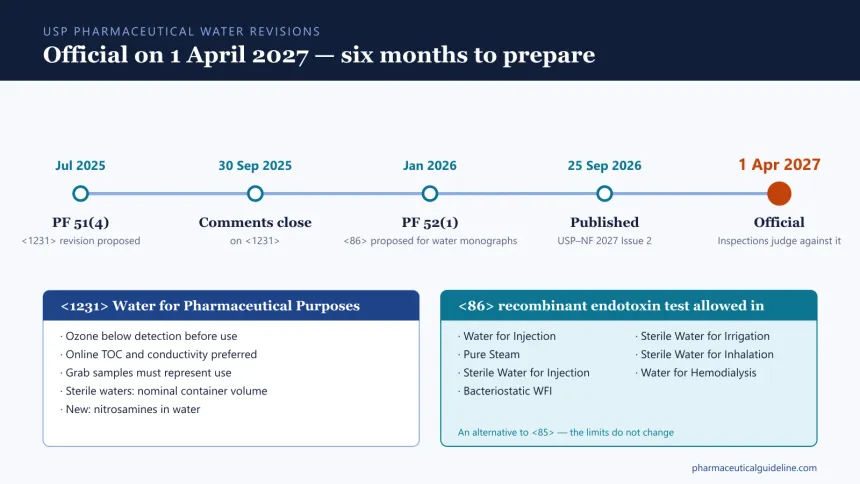
Two revisions to the way the United States Pharmacopeia treats pharmaceutical water become official on 1 April 2027. General chapter <1231> Water for Pharmaceutical Purposes has been revised, and the monographs for Water for Injection, Pure Steam and the sterile waters now name a second, animal-free bacterial endotoxin test. Both were published in USP–NF 2027 Issue 2 on 25 September 2026.
That leaves about six months. For most sites the work is not large, but two parts of it are slow — a nitrosamine assessment of the water system, and any change of endotoxin method — and both need to start now rather than in March.
Free tool
USP water revisions 2027: readiness tool
Every change with its binding status, a filter by dosage form, a roadmap to 1 April 2027 that remembers your ticks, and the questions auditors are likely to ask. No sign-up, and nothing leaves your browser.
What is binding, and what is not
Getting this right first saves a lot of argument later.
<1231> is an informational chapter. USP numbers its general chapters so that anything above 1000 is guidance, not an enforceable requirement. Nothing in <1231> can be cited, on its own, as the reason a batch fails.
That does not make it optional in practice. <1231> is the text an inspector uses to judge whether a water system is under control — how it is sanitised, sampled, monitored and trended. After 1 April 2027, the revised version is the yardstick, and “the old chapter said otherwise” stops being an answer.
The endotoxin change sits in binding monographs — but it adds an option rather than removing one. You may keep using the classical test.
For an Indian manufacturer, these revisions arrive through two doors: products for the United States, and any specification that cites the current USP. Products made only to the Indian Pharmacopoeia are governed by it. But many specifications in Indian plants are written “IP/BP/USP”, and every one that cites USP picks up the change on the official date whether anyone planned for it or not.
What changed in <1231>
The revision was proposed in Pharmacopeial Forum 51(4) in July 2025, with comments closing on 30 September 2025. USP can amend a proposal after comment, so check each point below against the official text before acting on it.
Ozone must be below the detection limit before use. Ozone is the usual sanitant for ambient Purified Water loops and common on cold WFI loops. The expectation is now explicit: before the water is used, residual ozone must be reduced below the detection limit. “The UV lamp is on” is not evidence. What is wanted is a measured residual at the points of use after each sanitisation, by a method whose detection limit you can state, recorded before the loop is released back to production.
Additives get a risk assessment. Anything added to the water or its system — sanitisers, pH adjusters, anti-scalants — and their by-products should be assessed for use, reduction and detection. Most sites can list what they add. Fewer can show how they know it has gone, and at what level they would see it if it had not.
Online measurement is preferred, and grab samples must represent use. The chapter now prefers online TOC and conductivity to offline testing, and insists that an offline sample represents the water as it is actually used. The quiet finding here is the sampling valve. If production draws water through a hose after a two-minute flush and QC samples from a clean port after thirty seconds, the sample describes a water nobody uses.
Conductivity offline may start at Stage 2. A sample carried to the laboratory absorbs carbon dioxide on the way — exactly what Stage 1 cannot forgive. For offline analysis, Stage 1 may now be omitted. A small SOP change, but one that stops analysts repeating a stage the chapter no longer expects.
TOC: the target limit response is not the limit. The difference between the two is clarified, with emphasis on official USP reference standards for system suitability. It is a common laboratory confusion, and one that turns up in investigations.
Sterile waters: container volume and packaging. “Nominal container volume” is now defined as the volume the container is designed to hold, whatever the actual fill. That matters because the sterile water monographs set different limits for small and large containers, so which volume counts decides which limit applies. The chapter also addresses volatile organics from packaging that contribute to the TOC result, with extractables identified, quantified and evaluated for toxicity during development. In a plastic container, part of a TOC result may be the container rather than the water.
New: nitrosamines in water. A new section asks for a risk-based assessment of nitrosamine formation and contamination in the water system, and a suitable control strategy. This is the genuinely new requirement in the revision, and the one most sites have never looked at.
Nitrosamine assessments so far have concentrated on the drug substance, the synthetic route and the excipients. Water was rarely in scope. Yet the pathways are well known from drinking-water chemistry: chloramine disinfection of municipal supplies is a recognised route to NDMA, anion exchange resins carry amine groups, anti-scalants can be amine-based, and nitrite can arrive in the feed water. In an oral liquid or a topical cream, water can be most of the product — so whatever the water carries goes straight into it.
The endotoxin change: an option, not an obligation
Proposed in PF 52(1) in January 2026, Bacterial Endotoxins Test Using Recombinant Reagents <86> is added as an alternative to <85> in seven monographs:
- Water for Injection
- Pure Steam
- Sterile Water for Injection
- Bacteriostatic Water for Injection
- Sterile Water for Irrigation
- Sterile Water for Inhalation
- Water for Hemodialysis
<86> uses animal-free, recombinant reagents instead of horseshoe crab lysate. The endotoxin limits do not change, and <85> remains available. Nobody has to switch.
If you do switch, three things follow. You verify the method for your water — supplier validation data reviewed, plus your own suitability tests. You keep comparative data against <85>, because regulators may ask for it. And for a product filed in the United States, you treat the switch as a change to an approved test method, with whatever notification that requires. None of that is quick, which is why the decision belongs in the first half of the six months, not the last.
Which dosage forms feel it most
| What you make | Waters involved | Impact | What matters most |
|---|---|---|---|
| Packaged sterile waters (SWFI, BWFI, irrigation, inhalation) | The product itself | Very high | Container volume, packaging TOC, <86> in each monograph |
| Sterile injectables and ophthalmics | WFI, Pure Steam | High | Ozone residuals, sampling at every point of use, nitrosamines, endotoxin method |
| Lyophilised products supplied with a diluent | SWFI, BWFI | High | The diluent’s container volume, packaging, and endotoxin method |
| Biologicals and vaccines | WFI, Pure Steam for SIP | High | Endotoxin method comparability in your matrix, steam condensate testing |
| Inhalation products | Sterile Water for Inhalation | High | <86> option, nitrosamines in nebuliser solutions |
| Oral liquids | Purified Water | Medium–High | Nitrosamines — water is often the largest ingredient |
| Topicals | Purified Water | Medium | Nitrosamines, additives, ozone |
| APIs | Purified Water for final washes | Medium | Nitrosamines in water used after the last purification step |
| Oral solids | Purified Water | Low–Medium | Ozone and sampling on the loop |
Impact ratings are this site’s judgement. Every QC laboratory testing to USP also has small SOP changes — conductivity, TOC wording, and method verification if <86> is adopted. The tool filters these by what you make.
The roadmap: six months to 1 April 2027
Phase 0 — October 2026: establish what you are working to. Get the official text in USP–NF 2027 Issue 2 and compare it with the proposals. List every specification, SOP and method that cites a USP water chapter or monograph. Decide scope by market. Name one owner and open one change control for the whole programme rather than a dozen small ones.
Phase 1 — November 2026: gap assessment and quick wins. Assess each water system against each change. Confirm your ozone residual method and its detection limit, and the UV destruction at points of use. Write the additives risk assessment. Walk the points of use with production and QC together, and compare how each draws water. Check the qualification, calibration and audit trail status of online TOC and conductivity analysers.
Phase 2 — December 2026 to January 2027: the new assessments. Carry out the nitrosamine risk assessment for each water system — source water disinfection, ion exchange resins, anti-scalants, elastomers in gaskets and diaphragms, nitrite in feed water. For sterile waters, settle nominal container volume in specifications and labels, and evaluate the packaging’s contribution to TOC.
Phase 3 — January to March 2027: methods and the endotoxin decision. Record a decision on <85> or <86> for each water. If adopting <86>, complete verification and comparison and assess the regulatory filing. Revise conductivity and TOC SOPs to the clarified wording.
Phase 4 — March 2027: close and prove. Train QC, engineering and production on what changed for each of them. Make revised documents effective on or before 1 April. Carry out a self-inspection of each water system against the revised chapter, and update the water system section of the product quality review.
What auditors will ask after 1 April
Expect the questions to follow the changes. Show me the residual ozone at the points of use after the last sanitisation. How do you know this QC sample represents the water production uses? Where is the nitrosamine risk assessment for the water system? Which container volume did you use to choose this sterile water limit? You moved to recombinant reagents — show me the verification.
And one that the revision does not mention but that follows from the preference for online measurement: who can change the alarm limits on the online TOC analyser, and where is that change recorded? An online analyser is a computerised system. If its configuration can be changed by the person whose results it judges, the data it produces carries the same weakness as any chromatography system with an analyst holding administrator rights.
Where to start this week
Three things cost almost nothing and remove most of the risk. Find out how many of your specifications cite USP, because that number is the true scope. Ask your engineering team what ozone residual method you use and what its detection limit is — if nobody knows, that is your first gap. And put the nitrosamine assessment of your water system on someone’s desk with a date, because it is the one item on this list nobody has done before.
Work out your own position: the USP water revisions tool shows every change with its binding status, filters by dosage form, and carries the roadmap as a checklist that remembers where you got to. For the waters themselves, this site’s series covers each one: Purified Water, Water for Injection, Pure Steam, the sterile monographed waters and source water considerations. If you make oral liquids in India, the revised Schedule M tool covers the Purified Water IP and glycol testing requirements of Part IX.
This article is a working aid prepared from the proposals published in Pharmacopeial Forum 51(4) and 52(1). It is not the official text. Where anything here differs from USP–NF 2027 Issue 2, the official text governs.
References
Get new articles
Practical GMP, QA and regulatory guidance for students and professionals, plus pharma job openings as they are posted. Free, about one email a week.
Related reading
 News and Updates
Shutdown of European Pharmacopoeia 10th Edition
European Pharmacopoeia (Ph. Eur.) 10th Edition has been obsolete since 1 January 2023. all previous versions are no longer been accessible.
 News and Updates
New paragraph on control of N-nitrosamines, Ph. Eur. revised General Monograph 2034 and 2619
Ph. Eur. Commission adopts revised general monographs 2034 and 2619 after inclusion of a new paragraph on control of N-nitrosamines
 Manufacturing and Packaging
WHO TRS 1044 (2022): 56th Report Annexes & PDF
WHO Expert Committee on Specifications for Pharmaceutical Preparations has published the Technical Report Series TRS 1044 2022 56th Report