
ISO 9001:2026: What Actually Changed, and What You Already Owed
ISO 9001:2026 is published and the transition runs to September 2029. What is genuinely new, what was already required before this edition, and what it means if you also work to GMP.
 Pharmaceutical Guideline6 min read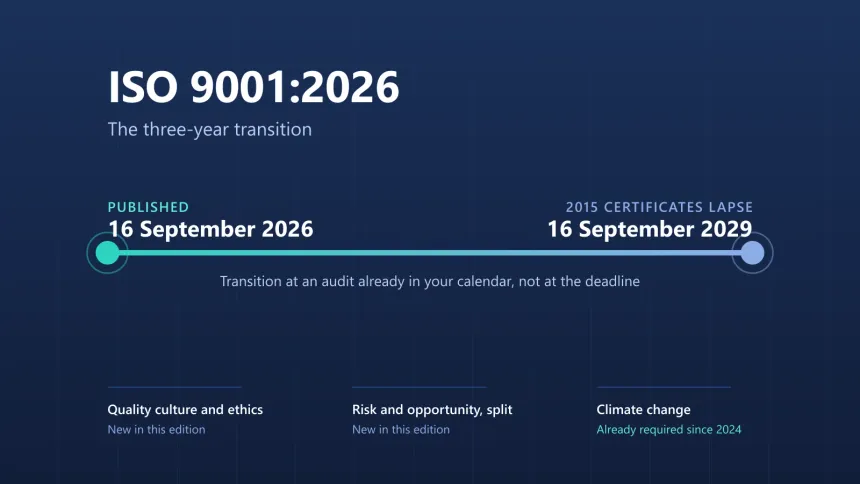
ISO 9001:2026 was published on 16 September 2026, the sixth edition of the standard. Certificates issued to ISO 9001:2015 stay valid through a three-year transition and then lapse, which puts the working deadline in September 2029.
Most of what has been written since publication lists the same handful of changes. One of those items is not a change at all, and mistaking it for one is the costliest error available to you right now.
Free tool
ISO 9001:2026 Transition Planner
The clause changes, when to book your audit, and a five-phase checklist that remembers where you got to. No sign-up, and nothing leaves your browser.
The thing that is not new
Nearly every transition checklist in circulation includes climate change under clauses 4.1 and 4.2, presented as a 2026 requirement to plan for.
It is not. Climate change entered ISO 9001 in February 2024, through Amendment 1 to the 2015 edition. That amendment took effect immediately. It carried no transition period, because ISO and the IAF treated it as a clarification of an existing requirement rather than a new one: you always had to determine the external issues relevant to your quality management system, and climate is one you must now show you considered.
ISO 9001:2026 carries that forward. It does not introduce it.
The practical consequence matters. If your context review still says nothing about climate change, you are not behind on a 2029 deadline — you have had an open gap since early 2024, and an auditor can raise it at your next surveillance visit. Treat it as a finding to close now, not a transition task to schedule.
Worth saying plainly: deciding that climate change is not material to your quality system is a perfectly acceptable answer. Failing to consider the question is not. The requirement is the determination and its reasoning, not any particular conclusion.
What genuinely changed
Two areas are substantively new.
Quality culture and ethical behaviour, in clause 5.1.1. Top management must now promote both, and be able to demonstrate that they do. This is the hardest requirement in the edition to evidence, because the usual instruments do not work. A signed policy proves nothing. What an auditor can test is whether the organisation behaves as the policy claims: what happened the last time someone stopped a line, whether a quality concern has ever overridden a delivery date, whether an operator’s description of the culture matches the framed statement on the wall.
The awareness requirements in 7.3 follow it. Staff now need to be able to say something real about quality culture and ethical behaviour, which means the training has to be about something.
Risks and opportunities, separated, in clause 6.1. The 2015 edition asked you to address “risks and opportunities” as one activity, and most organisations did exactly that — producing a register where every opportunity is a risk written backwards. Risk: the machine fails. Opportunity: the machine does not fail. That satisfied nobody and improved nothing.
The 2026 edition treats them as distinct. An opportunity is now something you chose to pursue and resourced: a process redesigned, a bottleneck removed, a capability added. Expect to be asked which opportunities you took up this year, who owned them, and what came of them. A short list of three real ones will survive that question; forty inverted risks will not.
What was clarified rather than introduced
Some changes read as new and are better understood as the standard catching up with what it already implied.
Clause 7.1.4, the environment for the operation of processes, now clearly covers psychological and social conditions — stress, workload, non-discrimination. The 2015 edition said this too, in a note listing exactly those factors including stress reduction and burnout prevention. What changes is visibility: a note is easy to skim past, a requirement is not. If your workplace environment assessment covers lighting, temperature and noise and stops, that gap was always there. It is simply going to be looked at now.
Clause 6.3, planning of changes, puts more weight on reviewing a change after it is made. Most organisations plan changes competently and then never revisit them, so the reviewable absence is any record that a completed change was checked for its effect on quality.
Clause 9.3, management review, reaches the new areas. Minutes are the cheapest evidence in the entire standard and reliably the thinnest. If culture, ethics and climate relevance were genuinely discussed, the minutes should read like a discussion rather than a line recording that they were noted.
What has not changed
The clause structure is the same. Clauses 4 to 10 remain where they were, the harmonised structure is intact, and the process approach and PDCA cycle are unchanged. Documented information requirements have not been rewritten.
This is an evolutionary revision. If your QMS genuinely works today, you are updating it, not rebuilding it — and anyone selling you a ground-up reconstruction is selling you something you do not need.
If you also work to GMP
Most readers of this site operate a pharmaceutical quality system under ICH Q10 and GMP, with ISO 9001 certification alongside it rather than instead of it. Two observations for that situation.
The culture requirement is the one place where the two systems now point in the same direction and can share evidence. ICH Q10 already expects management commitment, a quality policy, and a culture supporting continual improvement; GMP inspectors have been asking about quality culture and management oversight for years. The record you keep for one will largely serve the other — deviations raised without blame, concerns escalated and acted on, management review with genuine content.
The opportunity requirement is where they differ. Quality risk management under ICH Q9 is thoroughly embedded in most pharmaceutical systems, and that maturity does not transfer. Q9 is about risk. Clause 6.1.3 is about deliberately pursued improvement, which a GMP-led system often does informally and documents nowhere. That is the likelier gap for a pharmaceutical organisation, not the risk side.
A planner you can work through
We have built a free ISO 9001:2026 transition planner covering the clause changes, the timing decision, a five-phase plan with a checklist that remembers where you are, and the findings auditors are most likely to raise. It needs no sign-up, and the ticks stay in your own browser.
Two practical points on timing that the planner goes into further.
Your certification body cannot issue a 2026 certificate until its own accreditation body has assessed it and its auditors are retrained. Ask yours directly when it expects to be ready — that date, not your own readiness, sets the earliest you can move.
And work backwards from a surveillance or recertification visit already in your calendar rather than picking a date from the deadline. Transitioning at an audit you were having anyway is cheaper and less disruptive. Leaving it until 2029 costs you the one thing that matters most at the end of a transition window: enough margin to close a major finding before your certificate expires.
References
- ISO 9001:2026 Quality management systems — Requirements (opens in a new tab)
- ISO: ISO launches update to the world's most widely used quality management standard (opens in a new tab)
- ISO/TC 176/SC 2: ISO 9001 revision updates (opens in a new tab)
- BSI: ISO 9001:2026 key changes and guidance (opens in a new tab)
- ICH Q10 Pharmaceutical Quality System (opens in a new tab)
Get new articles
Practical GMP, QA and regulatory guidance for students and professionals, plus pharma job openings as they are posted. Free, about one email a week.
Related reading
 General
Deadline Dilemma: The Case for Extending Revised Schedule M to December 2026
As of January 2026, the Indian pharma sector faces a massive bottleneck: over 13,000 plants require inspection, yet only ~1,100 field inspectors are active. While the government has enforced Revised Schedule M, Laghu Udhyog Bharti is pushing for a vital extension until December 2026 to prevent the closure of thousands of MSMEs and ensure the continued supply of affordable medicine.
 QA
QAHow to Reduce Human Error in Pharmaceutical Operations
Why retraining alone rarely works, and the practical controls that reduce human error in pharmaceutical manufacturing, packaging and documentation.
 Manufacturing and Packaging
FDA Dosage & Administration Labeling Guidance — Docket No.
Draft guidance for industry entitled “Dosage and Administration Section of Labeling for Human Prescription Drug and Biological Products